At 9:15 on a Wednesday morning in May, the 3-to-6 classroom at Cobble Hill Children's House looks, from the doorway, almost still. Twenty-two children are at work. Two are washing a small wooden table with sponges and a yellow plastic bucket. One is laying out the pink tower on a green mat near the window.
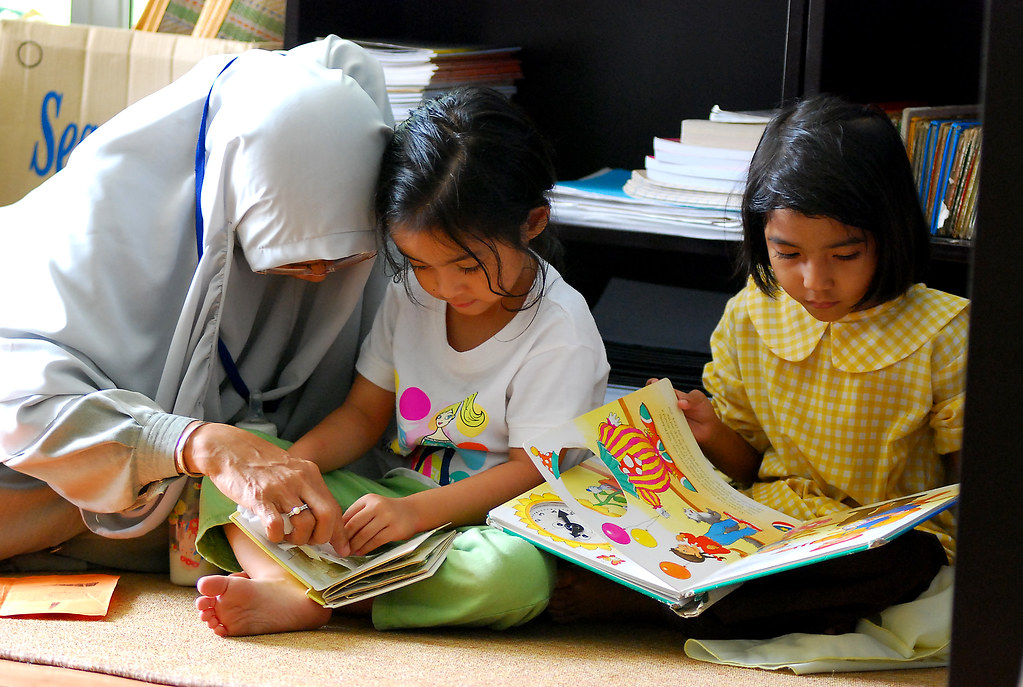
Anna Krijowsky, the lead guide, is sitting cross-legged on the floor with a four-year-old named Ezra, showing him how to fold a square of cloth into a triangle. She does it once. She does it again. She hands him the cloth and watches.
She has been there since 7:40, when the maintenance lights were still on and the morning's materials were not yet on the shelves.
The Cobble Hill Children's House occupies the ground floor of a brownstone on Court Street, a few blocks from the Brooklyn-Queens Expressway. It was founded in 2009 by a former public-school teacher named Patrice Halloran and a parent group of seventeen families. It now enrolls fifty-four children across two classrooms.
The 3-to-6, which is what Montessorians call the lower primary, runs from 8:45 to 3:15. Tuition for the 2025-26 school year is $34,400. About a third of families receive some form of partial subsidy through a quiet fund the parent association maintains.
Krijowsky trained at the Center for Montessori Teacher Education in White Plains in 2014. She came to Cobble Hill in 2019. Before that she taught for five years in a public Montessori magnet school in Hartford.
The room is laid out in four loose zones. Practical life is by the door — pouring stations, polishing trays, a low sink with child-sized aprons hanging from a brass hook. Sensorial is along the window wall. Language and mathematics share the back of the room. Art is in a corner with a child-height easel and a stack of newsprint pads.
Each material sits on a tray or in a basket on a low wooden shelf. Each one has a specific place. A child takes a tray to a rug, works with it, and returns it. The rug, rolled and standing in a tall basket, marks the workspace as the child's for that period.
Ezra finishes folding his cloth, more or less. He carries it back to the practical-life shelf. He does not look at Krijowsky for approval.
On the other side of the room, a five-year-old named Margot is working with the moveable alphabet. She has spelled out, in red and blue wooden letters, the word kat. She looks at it for a long minute and then, without saying anything, replaces the k with a c.
Krijowsky does not intervene. Later she will say that the moveable alphabet is, in her view, the single material that most justifies Montessori's whole architecture. "They write before they read," she says. "That order matters."
By 10:00 the room has reached what Maria Montessori called normalization — the long, calm working stretch in which children move through their chosen tasks with no apparent direction. A visiting parent, if they have not seen it before, often finds it disorienting.
There is no whole-group lesson at the start of the morning. There is no circle time. There is, instead, the work cycle, which the school protects for three uninterrupted hours.
A four-year-old named Iris asks the assistant, a quiet young woman named Beth Liu, for help with the binomial cube. Liu kneels next to her, lifts the lid of the wooden box, and shows her the first move. Then she steps back.
Around 11:15, three children are doing the metal insets at one table. Another is counting golden beads into stacks of ten. One is reading a small book about a fox aloud to herself in a whisper. Two have gone to the bathroom together without being asked.
The work period ends at 11:45 with what Krijowsky calls the cleanup song, which is not really a song so much as a low, slow hum she begins at the front of the room. Children begin, one by one, to return their materials to the shelves. The transition takes about eleven minutes.
Lunch is at noon. The children set the tables themselves. There are real glass cups. Last year, Krijowsky says, the school went through forty-three of them. "That is fine," she says. "Glass breaks. Children learn that glass breaks. We buy more glass."
The Montessori method, as practiced at Cobble Hill, is more particular and less mystical than its reputation suggests. The materials are precise. The teachers are highly trained. The day is structured around a small number of strong principles, repeated.
What is harder to describe, and what visitors often miss, is the affective texture of the room. Children are not being managed. They are also not running wild. They are doing something more like working — purposeful, unsurveilled, occasionally interrupted by small disputes that they often resolve themselves.
Krijowsky says the hardest part of her training was learning not to interrupt. "I came from a classroom where I was the engine," she says. "Here I am the road."
It is easy to romanticize a school like this one, and the cost of tuition is its own argument against doing so. Cobble Hill enrolls a particular set of families. The model travels imperfectly into public schools, though the Hartford magnet where Krijowsky once worked is one of several attempts.
Still, what the morning suggests is something simpler than method. It suggests that children, given materials they can actually use, and adults who can sit on the floor for an hour without saying anything, will often choose to work.
By 3:15 the room is quiet again. The shelves are full. Krijowsky is on the floor with a sponge, cleaning up a small puddle of water near the practical-life area, where someone, earlier, was learning to pour.