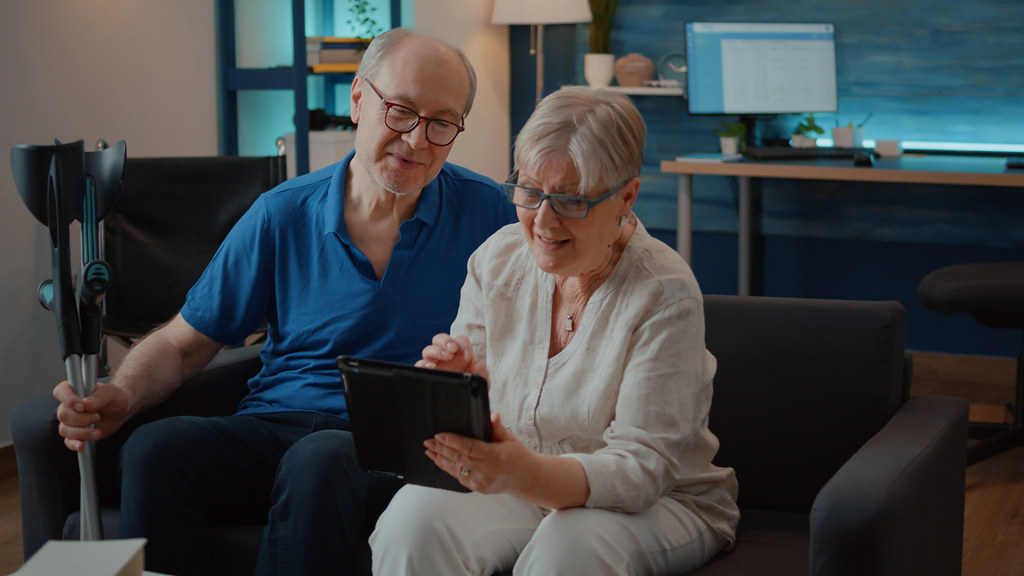
Eleanor Brennan is seventy-three and lives in Galway. Her grandson Theo is four and lives in Portland, Maine. They see each other, on a screen propped against a fruit bowl, every Tuesday and Saturday morning.
The call is at 8:15 in Maine and 1:15 in Galway, which works because Theo has finished his breakfast and Eleanor has not yet started her afternoon. The schedule has held, with a few weather-related cancellations, since November 2024.
Eleanor's daughter Maeve says the consistency is the point. The first attempts, three years ago, were spontaneous. A toddler does not understand spontaneity. He understood, eventually, that Nana lived in the iPad on Tuesdays.
What happens on the call is mostly small. Eleanor shows Theo what she had for lunch. Theo shows Eleanor a Lego boat that is not really a boat. They both wave a great deal. There are, by Maeve's count, an average of four minutes of actual content in a twenty-minute call.
The rest is presence. Eleanor stirs her tea. Theo eats a second piece of toast. Sometimes the call runs while Maeve does the dishes and Eleanor folds laundry, two kitchens connected by a thin tunnel of light.
This is not the only model. Across the country, in Davis, California, a family of four schedules a thirty-minute Sunday call with two sets of grandparents, back to back, like a Zoom funeral. Their seven-year-old has learned to perform.
The performance is not the connection. Mark Lambert, a developmental psychologist at the University of Vermont who has been studying digitally mediated grandparent relationships since 2019, says the most durable bonds form in the unstructured time.
Lambert calls it parallel presence. The grandparent is not entertaining the child. The grandparent is doing her own thing, in her own kitchen, while the child does his. The relationship grows in the spaces between the questions.
Eleanor learned this by accident. The first year, she planned activities. She read a book aloud. She did finger puppets. Theo, then two, watched for ninety seconds and wandered off. She felt, she said later, like a failed substitute teacher.
She stopped planning. She started cooking on camera. Theo, watching her dice an onion in her Galway kitchen at one in the afternoon, became transfixed. He asked if she could chop a carrot too. She did. He went and got his own plastic knife.
Now there is a recurring segment, unofficial, in which Eleanor and Theo prepare overlapping ingredients on opposite sides of the Atlantic. Maeve will set out a small bowl of cucumber slices. Eleanor will do the same. They eat together.
There are limits the technology will not solve. Eleanor has not held Theo since he was nineteen months old. She will fly to Portland in August, for ten days, and there will be a reunion in the airport that Maeve is bracing for, because Theo is now old enough to understand what he has missed.
Other families have built different scaffolds. The Okonkwo family in Atlanta, with grandparents in Lagos, mails physical objects in advance of calls. A small wooden bird. A bag of dried mango. The grandmother and the grandchild then handle the same object on camera, separately, together.
A family in San Diego, the Lukens, send a recorded bedtime story every Sunday night from grandparents in Tasmania. The grandfather, who is dying slowly, has now recorded sixty-two stories. The seven-year-old does not yet know about the dying. The recordings will outlast it.
What the screen cannot do is hold a small body in a lap. There is no software for the smell of an older person's hair, the particular cool of a grandmother's hand. Children notice these absences. So do the grandparents.
But there is a thing the screen can do that the rare in-person visit cannot, and it is the daily texture. The ordinary kitchen. The same mug. The slow accumulation of a relationship that does not depend on events.
Eleanor said something during a phone call last March that Maeve wrote down. She said, I know what he eats for breakfast. I know which spoon is his favourite. I know the song he sings to himself when he thinks no one is listening. That is not nothing.
Maeve framed the note, eventually, and stuck it inside a kitchen cabinet where she sees it when she reaches for the cereal bowls. The note is the only sentimental thing in her kitchen. She earned it.
The Tuesday and Saturday calls will not last forever. Theo will become eight, then twelve, and at some point he will not want to wave at a screen for twenty minutes. Eleanor knows this. She is collecting the calls now, while they are easy, against a later weather.
What she is making, twice a week, with a tablet propped on a fruit bowl, is something less than presence and more than nothing. It is a second living room. It will not be the only room he remembers. It will be one.