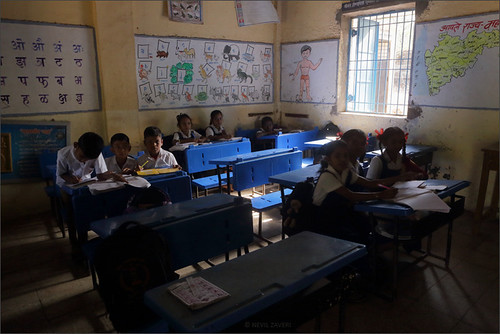
Hawthorne Academy sits on a residential block of the West Side of San Antonio, a few blocks east of the Guadalupe Cultural Arts Center. It serves about six hundred and twenty children prekindergarten through fifth grade, and its dual-language program, which began in 2002, now serves every grade.
In Room 207 on the second floor, a kindergarten teacher named Lupita Camarillo has been teaching the morning Spanish half of the dual-language day for twenty-one years. She came to Hawthorne in 2005 from a similar program in the Edgewood ISD, three miles to the west.
Camarillo's co-teacher, who teaches the afternoon English half, is a younger woman named Megan Pruitt, in her sixth year at Hawthorne. The two share twenty-two kindergartners. They plan together on Friday afternoons over coffee from the teacher's lounge.
The model used at Hawthorne is what dual-language educators call 50/50, in which half of the day's instruction is in each language and the same group of children moves between two teachers, each of whom teaches in only one language.
Camarillo's room is full of Spanish. The number line on the wall is labeled uno, dos, tres. The calendar reads mayo. The word wall, by mid-May, has eighty-seven words on it, in alphabetical order, written in Camarillo's careful print.
When the children enter at 7:45, she greets each one in Spanish. About a third of the class speaks Spanish at home. About a third speaks English only. The remaining third speaks a mix, or another language entirely. There are two children this year whose home language is Vietnamese, and one whose home language is Pashto.
Camarillo's classroom rule is simple and absolute: in the morning, in her room, only Spanish is spoken. The children, by May, do not push back. In September they did.
Morning meeting begins at 8:00. The children sit on a rug. Camarillo holds a small wooden frog she calls el sapo. Whoever holds the frog speaks. The first question of the day is, always, ¿Cómo te sientes hoy?
Children answer in one word, in Spanish. Feliz. Cansado. Bien. Triste. The English-only speakers learned the four basic words by the second week of school and now use them, by May, with the casual fluency of children who do not realize they are doing anything difficult.
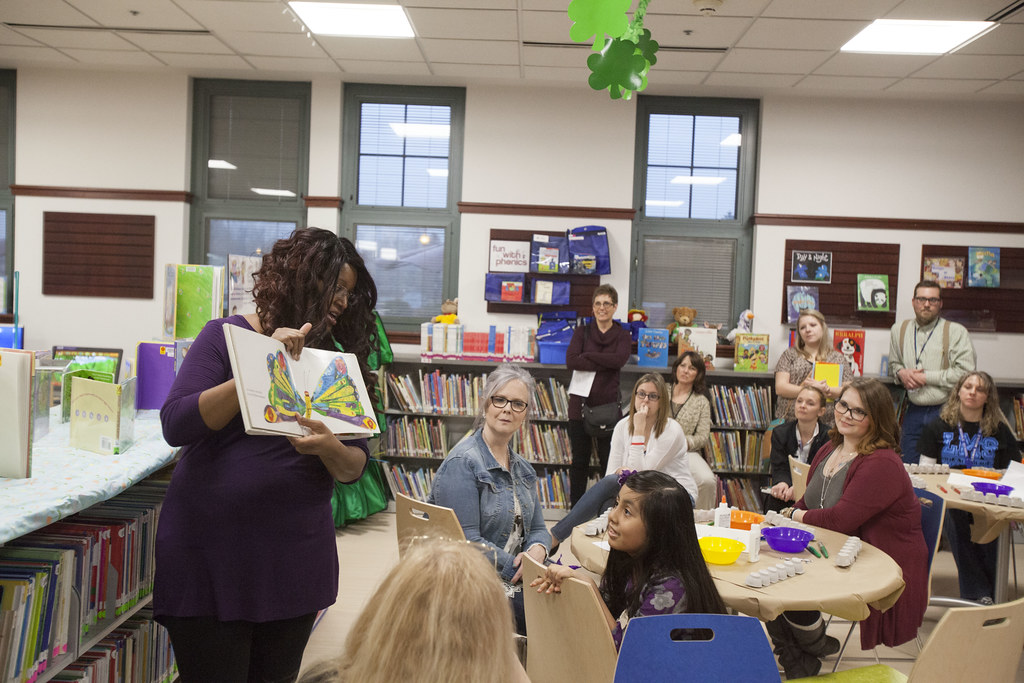
After morning meeting Camarillo reads a picture book aloud, in Spanish. Today's book is La Mariposa by Francisco Jiménez. She has read it three times this year. The children, when she pauses, fill in the next word.
The literacy block in Spanish runs from 8:30 to 9:45. Camarillo uses a curriculum called Estrellita, which the district adopted in 2017. It teaches the Spanish phonetic system in a sequence designed for native and non-native speakers.
Today the lesson is on the syllables ma, me, mi, mo, mu. The children chant. They write the syllables on small whiteboards. They combine syllables into words. Mamá. Mimo. Mesa.
The dual-language program at Hawthorne is technically optional. Families choose into it at kindergarten enrollment. The school maintains a waitlist; demand exceeds supply by about thirty percent each year.
The principal, a former dual-language teacher herself named Yolanda Esparza, says the program's persistence depends on three things. It depends on teachers who can teach across the language line. It depends on parents who are willing to trust a process that, for the first year, can feel slow. And it depends on a district that is willing to fund two teachers per classroom.
Recess is at 10:00, on the asphalt yard behind the school. The children play in both languages. Two girls jumping rope are counting in Spanish. Three boys racing each other to the fence are shouting in English.
After recess, math, also in Spanish. Today's lesson involves counting groups of objects up to twenty. The children count rocks Camarillo has gathered, over many years, from her family's land in Bandera County.
Lunch is at 11:15. The children eat in the cafeteria. After lunch they return to Camarillo's room for one more block of Spanish — a writing time, in which they each write one sentence in Spanish in a small bound journal.
At 12:30 the children switch rooms. They walk in a line across the hall to Megan Pruitt's room. They enter, and the language of the day becomes English. They greet Pruitt in English. They will spend the next three hours, until 3:30, in English.
Pruitt teaches the same content from a different angle. The book today, in English, is The Color of Us by Karen Katz. The literacy lesson is on the digraph sh.
The two teachers do not translate for each other. The children are not told that the Spanish word for shoe is zapato. They figure it out, slowly, by living in both languages.
By third grade, research from the district shows, children in the program are scoring at or above their English-only peers on state tests in English, while also performing at grade level in Spanish. The gap widens further in the children's favor by fifth grade.
Camarillo is not, when asked, especially interested in the research. She has been teaching long enough to know that the research is true, and also that the research is not what makes the classroom work.
What makes the classroom work, she says, is the frog. And the calendar. And the eighty-seven words on the wall. And the children, who, by May, know more about how language actually moves than most adults will admit to themselves.